
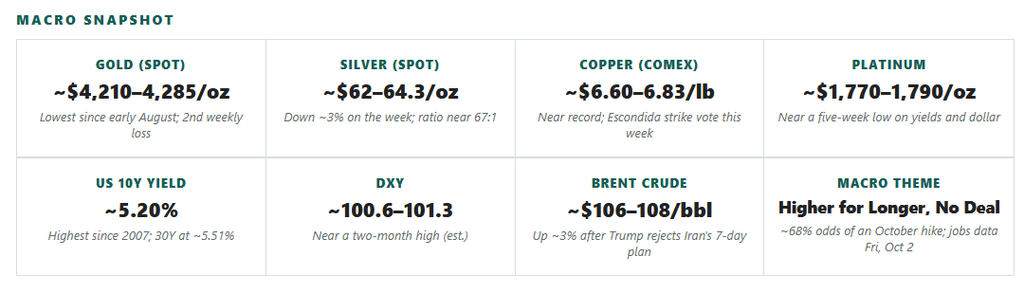
GOLD · ~$4,210–4,285/oz “Yields at a Two-Decade High Are Overpowering Every Safe-Haven Bid”
WHAT HAPPENED. Gold gave up its post-Fed bounce from the prior edition, finishing last week with a loss of more than 2% and settling near $4,285 on Friday, September 25. The slide resumed at Monday’s open, with spot gold dipping to about $4,209 in early Asian trading on September 28 its weakest level since early August. The metal now sits roughly 25% below its January record of $5,589.
WHY IT HAPPENED — PRIMARY DRIVER (RATES, NOT FEAR). The Fed’s 25bp hike to 3.75–4.00% on September 16 has been followed by data that keeps tightening on the table: US business activity expanded at its fastest pace in more than five years and weekly jobless claims fell to a near 60-year low. Markets now price roughly a 68% chance of another hike in October and about 95% by December (CME FedWatch). The result has been a bond rout the 10-year Treasury yield has climbed to about 5.20%, a level last seen roughly two decades ago, and the 30-year to 5.51% which raises the opportunity cost of holding non-yielding bullion just as the dollar trades near a two-month high.
SECONDARY DRIVER (AN OIL PREMIUM THAT WON’T FADE). Hopes for a phased US–Iran arrangement to reopen the Strait of Hormuz faded over the weekend. President Trump rejected Iran’s conditional seven-day plan to reopen the Strait which was tied to lifting the US naval blockade and easing economic pressure and reportedly told aides he expects US strikes to resume after the November midterm elections, though he also said he expects negotiators to keep talking this week. Brent jumped roughly 3% to about $107, and the renewed oil premium is feeding the rate-hike narrative that has been weighing on gold for most of September rather than lifting it as a hedge.
SCENARIOS. Physical demand has repeatedly appeared on dips below $4,300, and Indian buying picked up ahead of the festive season, but that floor has now been tested.
- Bull case: soft jobs data on Friday cools October hike odds, yields retreat from two-decade highs, and gold recovers above $4,300.
- Bear case: a hot PCE print and strong payrolls cement an October hike, sending gold toward the $4,150 support zone flagged by technicians.
- Main catalyst: the Fed’s preferred inflation gauge and Friday’s US employment report.
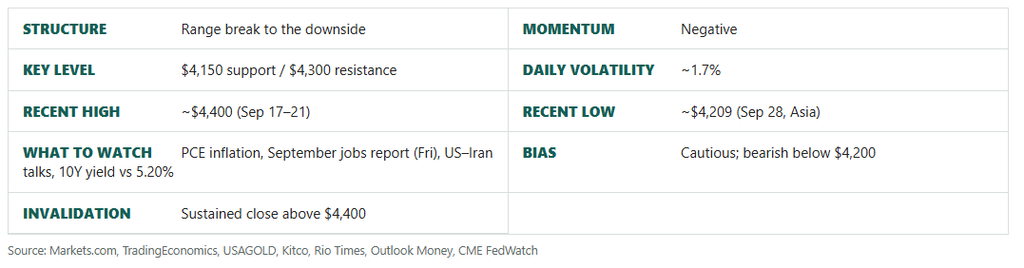
SILVER · ~$62–64.3/oz “Higher Beta Cuts Both Ways: A 3% Weekly Loss and Little Cushion”
WHAT HAPPENED. Silver closed last week around $64.29 (Friday, September 25) after a weekly decline of roughly 3%, and fell as much as 3% on Monday alongside gold as yields pushed higher. The gold-silver ratio sits near 66.8, tighter than the 67–70 range of recent weeks.
WHY IT HAPPENED. The same real-yield and dollar squeeze hitting gold is hitting silver harder: silver’s weekly loss of 3.1% compares with 2.2% for gold, consistent with its higher beta to rate expectations. Silver has also fallen sharply from its early-year parabolic peak and remains prone to single-session swings above 3%.
INDUSTRIAL DEMAND & PHYSICAL DEFICIT. The multi-year physical-deficit thesis is unchanged, and the fact that US manufacturing activity is running at a multi-year high supports industrial offtake, but the paper price is being set by rates.
- Bull case: yields stabilise and silver reclaims $67–70.
- Bear case: a hawkish data run drives a retest of the $58–60 shelf last seen in early August.
- Main catalyst: PCE inflation and Friday’s jobs report.
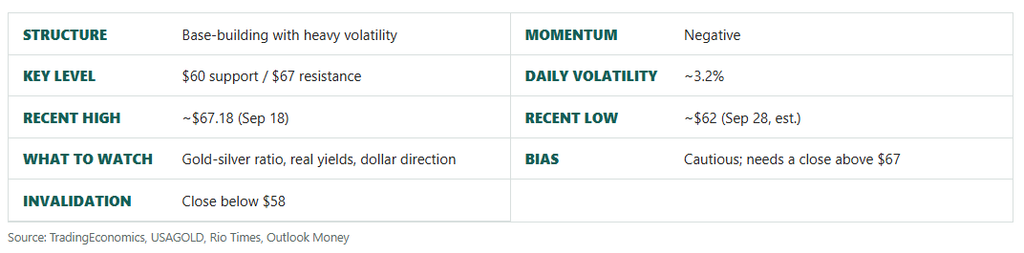
COPPER · ~$6.60–6.83/lb “The Metal Ignoring the Rate Shock, With Two Binary Risks Due This Week”
WHAT HAPPENED. Copper has held up far better than the precious metals, trading around $6.70/lb on COMEX after touching what one source cites as a record near $6.83 on September 22, with LME copper reported around $14,800 per tonne the following day. The LME prompt spread widened to its highest level of the month, a sign of tight nearby physical supply, and US manufacturing activity surged in September.
WHY IT HAPPENED — SUPPLY (PRIMARY DRIVER). The COMEX–LME divergence remains the defining feature: COMEX is estimated to hold roughly 69% of global exchange copper stocks after 18 months of tariff-driven flows, leaving LME readily available inventory at only about 90,000–134,000 tonnes, and pushing the LME cash-to-three-month spread into its sharpest backwardation since 2021. That premium is tied to a White House decision on a proposed 15–30% duty on refined copper that still has no announced date.
DEMAND (SECONDARY DRIVER). Electrification, data-center and grid demand keep the structural case intact, and are helping the metal look through the rate shock.
- Bull case: the tariff is confirmed or a strike disrupts Escondida, pushing copper to fresh records.
- Bear case: a softer tariff outcome releases US-stored metal back to LME, or LME stocks already up roughly 20% since mid-August keep building.
- Main catalyst: the Escondida strike vote (September 28–30) and any White House tariff announcement.
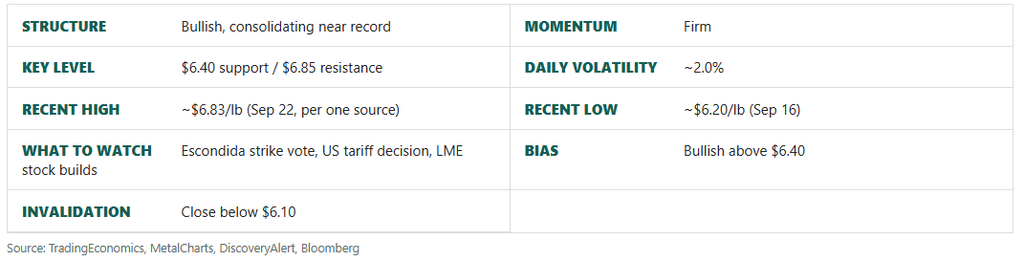
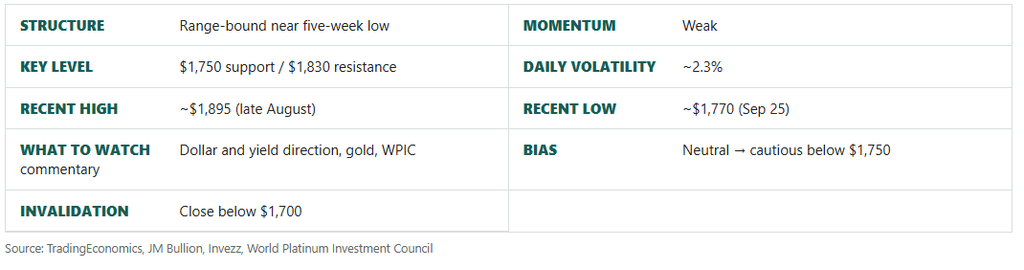
PLATINUM · ~$1,770–1,790/oz “A Five-Week Low, and a Supply Story That Has Turned Less Supportive”
WHAT HAPPENED. Platinum futures traded around $1,770/oz, near a five-week low, before ticking up to roughly $1,777–1,790 into the weekend, as surging yields and dollar strength reduced demand for non-yielding metals. The metal is down about 3.6% over the past month but still about 12% higher than a year ago.
SUPPLY & DEMAND BALANCE. The fundamental picture is more mixed than in earlier editions: the WPIC now forecasts industrial demand up 5% in 2026 but automotive demand down 4%, and the market is projected to post a 265,000-ounce surplus this year. That takes away the deficit narrative that had been cushioning platinum on pullbacks, leaving it more exposed to macro flows.
SCENARIOS. Bull case: the dollar rolls over from its two-month high and platinum reclaims $1,830. Bear case: yields keep climbing and platinum breaks below $1,750 toward $1,700. Main catalyst: gold direction and Friday’s jobs report.
This report is for informational purposes only and does not constitute investment advice. All prices are approximate and subject to market conditions. · Pan Asia Market Intelligence · 28 September 2026