GOLD · ~$4,368–4,400/oz “A Hawkish Hike, But the First Weekly Gain in a Month”
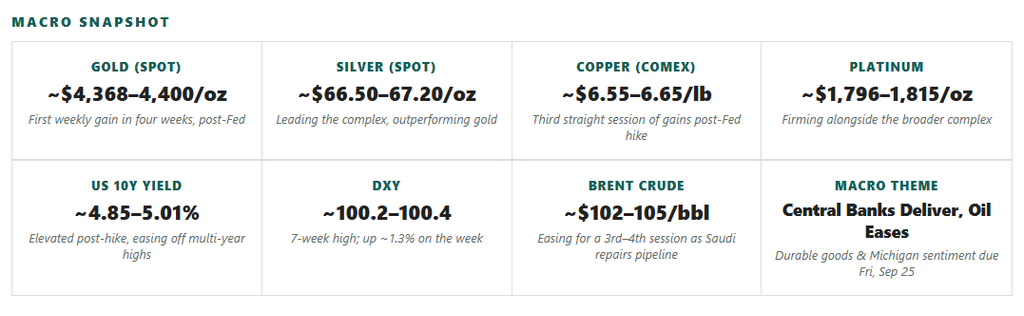
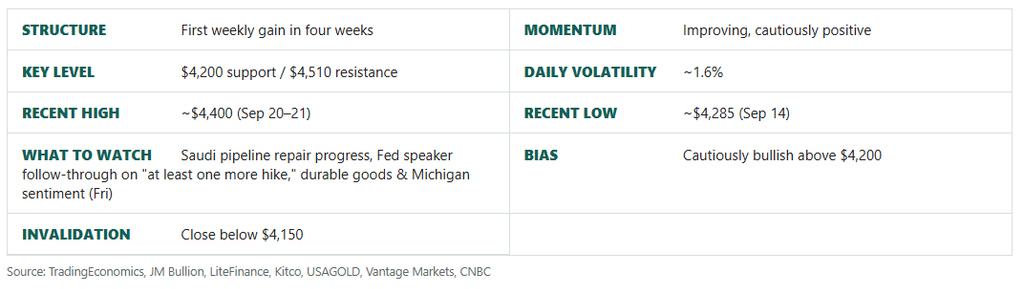
WHAT HAPPENED. Gold has snapped a three-week losing streak, edging up to a one-week high near $4,380 on Friday, September 18, and extending its recovery into the new week to trade around $4,368–4,391. The rebound has been driven less by the Fed decision itself which was fully priced in and more by what happened to oil and yields in its aftermath.
WHY IT HAPPENED — PRIMARY DRIVER (THE HIKE LANDED, THEN OIL GAVE GOLD ROOM TO BREATHE). The FOMC unanimously raised the federal funds rate by 25 basis points to 3.75%–4.00% on Wednesday, September 16 the Fed’s first hike since 2023 and Chair Kevin Warsh reaffirmed the central bank’s commitment to taming inflation while signalling at least one more hike is likely later this year. Markets now price roughly a 60% chance of a further increase next month. Crucially, falling oil prices in the days after the decision dragged Treasury yields down from their multi-year highs, reopening room for gold to climb even as the hike itself was a headwind.
SECONDARY DRIVER (A FIRMER DOLLAR AND TWO MORE CENTRAL BANKS IN PLAY). Gains were capped by a stronger dollar, which climbed to a seven-week high near 100.4 on Friday and is up roughly 1.3% for the week, helped along by a weaker yen after the Bank of Japan raised its own policy rate by 25 basis points as expected though two BOJ policymakers dissented against the move, a sign the pace of further Japanese tightening may be slower than markets had priced. The Bank of England separately left rates unchanged on Thursday but cautioned that a prolonged Middle East conflict could eventually force its own hand.
SCENARIOS. Institutional targets remain unchanged and mostly sit at or above current levels Goldman Sachs ($4,900), Bank of America ($4,360), HSBC ($4,560 average) implying the sell side still sees this week’s rebound as more sustainable than a dead-cat bounce.
- Bull case: Saudi Arabia’s pipeline repairs stall or a fresh Hormuz incident reopens the war-risk premium, pushing gold back above $4,500.
- Bear case: the pipeline is fully restored faster than the six-week estimate and the dollar’s rate-differential advantage widens further, pulling gold back toward $4,200.
- Main catalyst: further Saudi East-West pipeline repair updates, and Friday’s durable goods orders and University of Michigan consumer sentiment data.
SILVER · ~$66.50–67.20/oz “Leading the Rebound, True to Its Higher Beta”
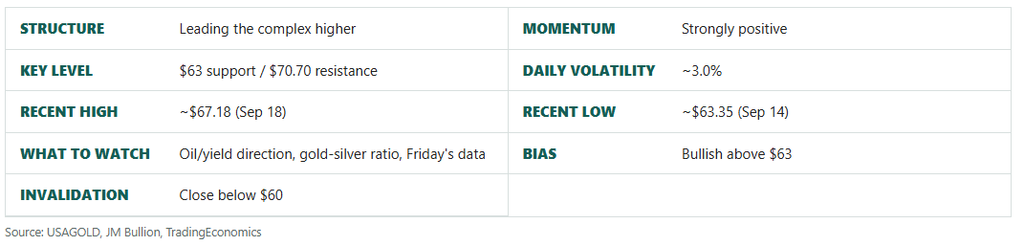
WHAT HAPPENED. Silver has outpaced gold’s recovery, jumping to $67.18 on Friday, September 18 up 3.02% on the day as physical gold extended its post-Fed rebound for a second straight session. The metal is holding those gains into the new week, trading around $66.50–67.00.
WHY IT HAPPENED. Silver’s higher beta to real yields is working in its favour on the way up just as it worked against it during the pre-FOMC selloff: the same pullback in oil and Treasury yields that lifted gold gave silver an outsized boost, consistent with the pattern that has defined this metal’s moves in both directions all year. The gold-silver ratio has compressed back toward the low end of its recent 67-to-70 range.
INDUSTRIAL DEMAND & PHYSICAL DEFICIT. The structural deficit thesis remains unchanged a sixth consecutive annual deficit is forecast for 2026 and continues to provide a longer-term floor beneath the metal’s real-yield-driven swings.
- Bull case: oil and yields keep easing on continued Saudi pipeline repair progress, and silver pushes back toward $70+.
- Bear case: a fresh Hormuz or pipeline setback reverses the yield decline, or Friday’s data surprises hot, sending silver back toward $60–62.
- Main catalyst: continued oil/yield direction, and Friday’s durable goods and consumer sentiment data.
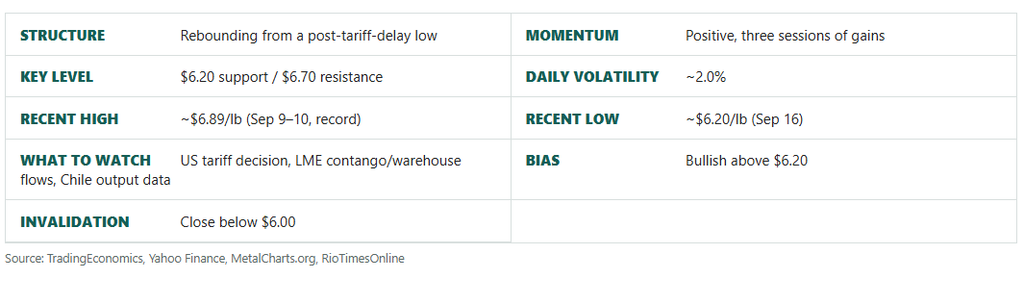
COPPER · ~$6.55–6.65/lb “Rebounding With the Complex, Even as Warehouse Deliveries Signal Supply Relief”
WHAT HAPPENED. Copper has staged a sharp recovery, climbing from a post-tariff-delay low near $6.20/lb on September 16 — its lowest since July to around $6.62/lb by September 18–19, a third consecutive session of gains as the broader metals complex rebounded following the widely anticipated Fed rate hike.
WHY IT HAPPENED — SUPPLY (PRIMARY DRIVER). Earlier in the week, copper had dropped to multi-week lows on confirmation that the Trump administration had indeed postponed its decision on refined-copper tariffs, exactly the policy uncertainty flagged in the prior edition. Since then, the metal has been supported by continued expectations of sustained long-term consumption from data centers and renewable energy projects, alongside supply disruptions at several major mines. At the same time, LME-monitored warehouses recorded fresh deliveries, with inflows reaching their highest level in nearly four weeks, pushing London copper into contango a structure that signals ample near-term availability even as the longer-run supply story (Escondida’s falling ore grades, Codelco’s El Teniente disruption) remains tight.
DEMAND (SECONDARY DRIVER). AI data-center and grid-electrification demand remain the unchanged structural driver.
- Bull case: the tariff decision is eventually confirmed and the current contango unwinds as US stockpiling resumes, pushing copper back toward its recent record above $6.85.
- Bear case: continued warehouse inflows keep the market in contango and the tariff stays shelved indefinitely, capping copper below $6.70.
- Main catalyst: any formal update on the US refined-copper tariff, and whether LME contango persists or narrows.
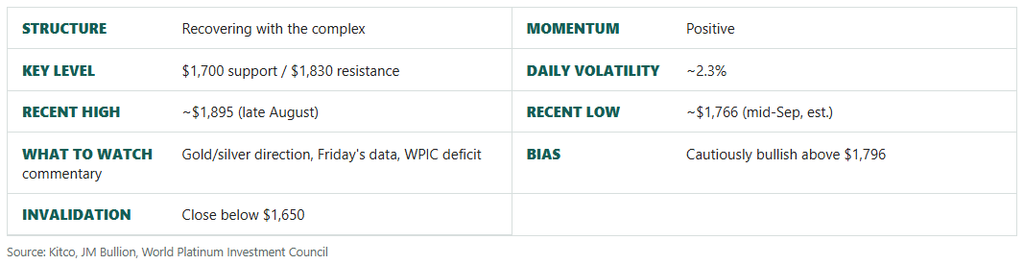
PLATINUM · ~$1,796–1,815/oz “Firming Alongside Gold and Silver in the Post-Fed Rebound”
WHAT HAPPENED. Platinum has climbed alongside the rest of the complex, rising 1.64% to trade near $1,796–1,812/oz on September 18–19, recovering a portion of the ground lost during the pre-FOMC selloff the week before.
SUPPLY RISK (PRIMARY DRIVER). The structural case is unchanged: the World Platinum Investment Council continues to project a fourth consecutive annual supply deficit for 2026, with constrained South African mine supply and elevated energy costs the persistent headwinds. This week’s move has been driven almost entirely by the same oil/yield/dollar dynamics moving gold and silver rather than by fresh platinum-specific news.
DEMAND RISK & LONG-TERM CATALYST. The continued shift toward electric vehicles remains a cloud over the demand outlook even against the tight-supply backdrop, while China’s expanding hydrogen fuel-cell fleet remains the structural long-term catalyst.
- Bull case: the broader precious-metals rebound extends and platinum breaks back above $1,830.
- Bear case: the dollar’s post-Fed strength persists and pulls the whole complex back down, sending platinum toward $1,700.
- Main catalyst: gold/silver direction and Friday’s economic data.
This report is for informational purposes only and does not constitute investment advice. All prices are approximate and subject to market conditions. · Pan Asia Market Intelligence · 21 September 2026