GOLD · ~$4,140–4,212/oz “Fed Odds Flipped in a Week, But Gold Still Can’t Hold the Bounce”
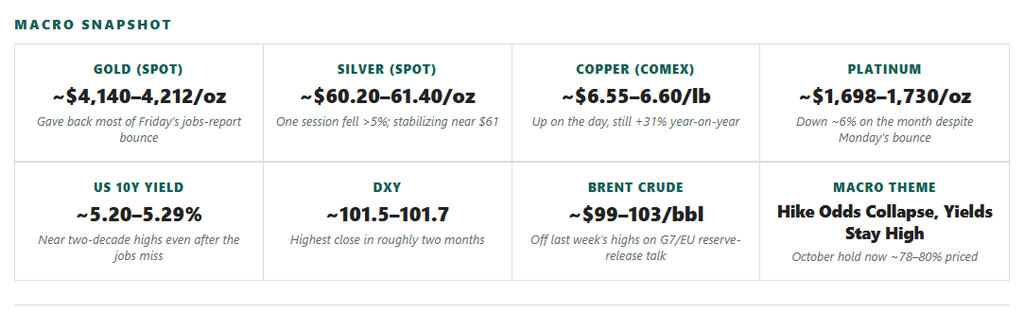
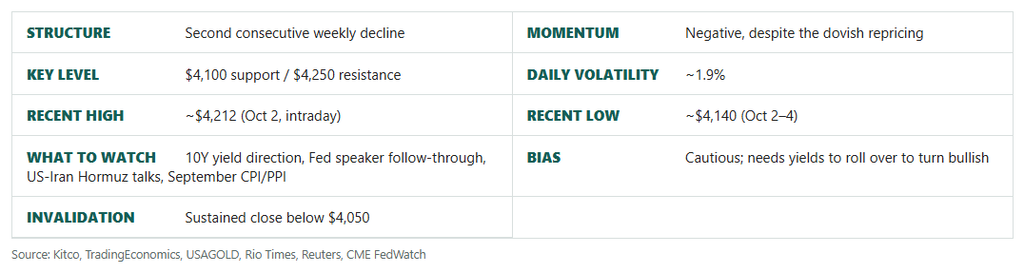
WHAT HAPPENED. Gold had a genuinely volatile week, falling 3% to a seven-week low of $4,156.45 on Monday, September 28 as Brent spiked on the collapse of US-Iran Hormuz talks, before clawing back some ground mid-week on soft inflation data. Friday’s September jobs report then triggered a sharp but short-lived rally to around $4,192–4,212, only for gold to give back most of that bounce by the close as elevated yields and a firm dollar reasserted themselves ending the week near $4,140–4,156, its second consecutive weekly decline.
WHY IT HAPPENED — PRIMARY DRIVER (A GENUINE LABOUR-MARKET CRACK).US payrolls rose by just 29,000 in September, well below forecasts, while the unemployment rate ticked up to 4.2%. The reaction in rate-hike pricing was dramatic: CME FedWatch odds of an October hike collapsed to roughly 20–22%, down from as high as 70% earlier in the same week one of the sharpest repricings of the entire cycle. Fed Governor Philip Jefferson and New York Fed President John Williams both called for “more time to assess” whether further tightening is needed, reinforcing the dovish shift.
SECONDARY DRIVER (YIELDS REFUSE TO COOPERATE). Despite the collapse in hike odds, the 10-year Treasury yield only briefly dipped before recovering to around 5.25%, and the dollar closed at its highest level in roughly two months both still reflecting concerns about elevated long-term borrowing costs that Cleveland Fed President Beth Hammack has linked to fiscal and debt dynamics rather than the near-term policy rate alone. Earlier in the week, the breakdown in US-Iran talks over reopening the Strait of Hormuz with Trump threatening to “crush Iran’s economy” even as Iran’s President Pezeshkian called for an end to the war had pushed Brent briefly above $107, adding to the inflation-risk backdrop that is keeping long-end yields elevated even as near-term hike odds fade.
SCENARIOS. Gold is now about 26% below its January intraday peak of $5,595.62, with the rate-vs-yield tug-of-war the defining feature of the market.
- Bull case: yields finally follow hike odds lower as more soft data arrives, and gold reclaims $4,250–4,300.
- Bear case: yields stay anchored near 5.2–5.3% on fiscal/term-premium concerns regardless of the Fed’s near-term path, capping gold below $4,200.
- Main catalyst: whether Treasury yields begin to track the newly dovish Fed pricing, and any further US-Iran developments.
SILVER · ~$60.20–61.40/oz “A Brutal Mid-Week Drop, Then a Tentative Stabilization”
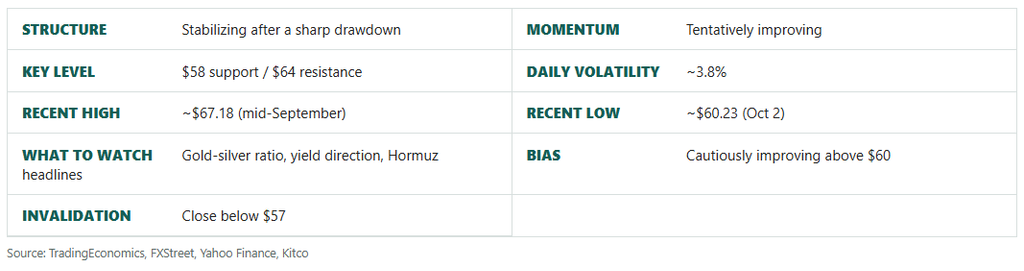
WHAT HAPPENED. Silver had one of its roughest stretches of the year, falling more than 5% in a single session around September 29 as oil and yields surged together, before steadying through the PCE and jobs-report news flow to trade around $61.39 on Monday, October 5, up 1.7% on the day. The metal is still down roughly 7% over the past month, though it remains about 26% higher than a year ago.
WHY IT HAPPENED. Silver’s higher beta has cut sharply in both directions this cycle: it fell harder than gold on the mid-week yield spike and is now recovering in step with the broader dovish repricing, helped by more positive signals on Middle East oil movement easing some of the inflation-risk overhang. The gold-silver ratio has drifted back up to around 68.5, reflecting silver’s underperformance over the past month even as it leads the latest bounce.
INDUSTRIAL DEMAND & PHYSICAL DEFICIT. The structural deficit thesis remains unchanged and continues to provide a longer-run floor, even as the metal’s day-to-day moves are dominated by the rates and oil narrative.
- Bull case: yields follow the dovish Fed repricing lower and silver reclaims $64–67.
- Bear case: yields stay elevated and oil reasserts itself, pulling silver back toward the $57–58 shelf.
- Main catalyst: 10Y yield direction and further Hormuz/Iran headlines.
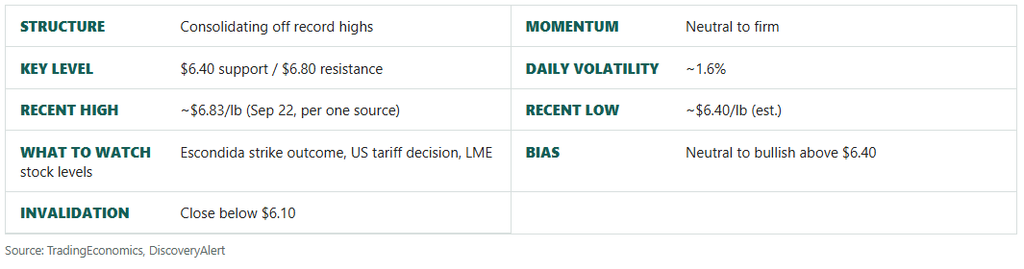
COPPER · ~$6.55–6.60/lb “Still Up Sharply on the Year, Even as It Cools From September’s Record”
WHAT HAPPENED. Copper has eased from the records touched in mid-to-late September, trading around $6.57/lb on Monday, October 5, up 1.17% on the day but down 2.54% over the past month while still up a striking 31.29% year-on-year. The pullback from its highs has been orderly rather than a sharp reversal, consistent with the gradual easing flagged in the prior edition as LME warehouse deliveries picked up.
WHY IT HAPPENED — SUPPLY (PRIMARY DRIVER). The two binary risks flagged last week the Escondida strike vote and the pending US refined-copper tariff decision remain unresolved, keeping the COMEX-LME premium and the broader policy premium intact without a fresh catalyst in either direction this past week. The underlying structural tightness (COMEX holding the bulk of global exchange stocks, LME inventories still thin) continues to underpin prices even as the metal consolidates off its highs.
DEMAND (SECONDARY DRIVER). Electrification and AI data-center demand remain the unchanged long-run driver.
- Bull case: an Escondida strike goes ahead or the tariff is confirmed, reigniting the move toward fresh records.
- Bear case: a labour deal is reached and the tariff decision disappoints, allowing the recent consolidation to deepen.
- Main catalyst: resolution of the Escondida strike vote and any formal US tariff announcement.
PLATINUM · ~$1,698–1,730/oz “A Monday Bounce, But Still Down Sharply on the Month”
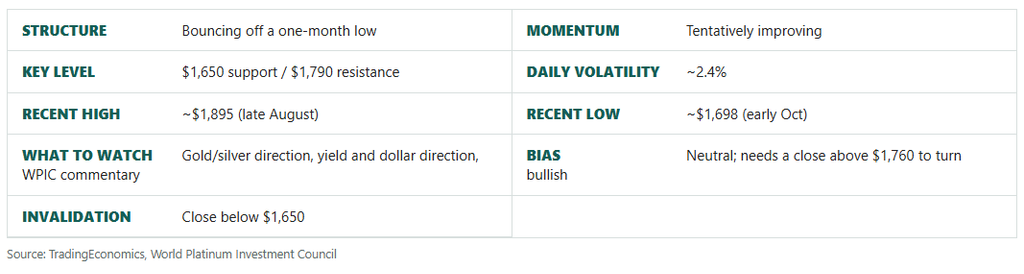
WHAT HAPPENED. Platinum rose to around $1,730.10 on Monday, October 5, up 1.77% on the day, rebounding alongside the rest of the precious-metals complex on the dovish jobs-report repricing. The gain only partially offsets a rough month platinum is still down roughly 6.1% over the past 30 days, even though it remains about 6.3% higher than a year ago.
SUPPLY & DEMAND BALANCE. The fundamental picture flagged in the prior edition remains in place: the WPIC’s 2026 outlook of a 265,000-ounce surplus, driven by a projected 4% drop in automotive demand even as industrial demand rises 5%, has left platinum more exposed to the same macro swings buffeting gold and silver rather than cushioned by a deficit narrative.
- Bull case: yields roll over meaningfully and the broader precious-metals rebound extends, carrying platinum back above $1,760.
- Bear case: yields stay elevated near 5.2%+ and the dollar holds its two-month high, pulling platinum back toward $1,650–1,700.
- Main catalyst: gold/silver direction and the path of Treasury yields.
This report is for informational purposes only and does not constitute investment advice. All prices are approximate and subject to market conditions. · Pan Asia Market Intelligence · 5 October 2026